
A psychological drama that mutates into a strange sci-fi allegory
Bugonia, the latest film by Greek auteur Yorgos Lanthimos, has finally surfaced online in high quality, allowing a wider audience to watch and dissect it. The film behaves like a sealed puzzle box filled with psychological tension, exploring themes such as paranoia, conspiracy thinking, and existential despair. As the narrative escalates, Bugonia pushes viewers toward a sensation of emptiness before landing on a genuinely shocking conclusion. What begins as an intimate psychological drama soon expands into something stranger, more philosophical, and deeply unsettling.

The story centers on Teddy, a beekeeper who has fallen completely under the influence of an elaborate conspiracy theory. He firmly believes that issues like medical poisoning, environmental collapse, and mass mortality are all part of a vast extraterrestrial plan to conquer Earth. In his mind, the only way to stop this cosmic plot is to infiltrate the aliens’ spaceship and confront their emperor.
Together with his naïve cousin, Don, Teddy kidnaps Michelle — a powerful pharmaceutical CEO whom he believes to be a disguised extraterrestrial orchestrating humanity’s downfall. After shaving her head and chaining her to a bed in his basement, the film shifts into a psychological battlefield where inner demons, philosophical anxieties, and violent delusions collide.

Teddy’s paranoia and his deep mistrust of the capitalist world form the spine of the film. The first half of Bugonia is devoted to mapping the contours of his psyche, giving the audience just enough logic to understand how he perceives reality. Lanthimos uses frantic framing, suffocating close-ups, and erratic behavior to communicate Teddy’s inner unraveling. At first, viewers simply assume Teddy is a dangerous man suffering from delusional thinking — someone who has abducted a wealthy woman in order to torture her.
But gradually, the film begins dropping clues about the origins of his paranoia. Teddy’s painful past, particularly his intense emotional dependence on his mother and the grief he experienced during her illness, has left him hollow and disoriented. This vacuum of meaning pushes him toward creating a conspiracy theory large enough to fill the void. Like many people facing uncontrollable loss, he constructs an external enemy—aliens, in this case—to give shape to his fear and anger.

This idea feels reminiscent of the early days of the COVID-19 pandemic, when collective trauma triggered massive spikes in conspiracy thinking. Regardless of whether such theories were true or false, they emerged from a shared desire to assign blame, to find meaning, to process chaos. In a similar way, Bugonia uses a surreal narrative to explore the existential aftershocks of grief and the human mind’s tendency to invent order in the face of despair.
Teddy becomes a symbolic product of his own inner void, transforming vulnerability into aggression. His paranoia and obsession with an imagined extraterrestrial threat serve as coping mechanisms for pain he cannot face directly.
One of the film’s strongest qualities is its exceptional acting, particularly from Jesse Plemons and Emma Stone. Plemons delivers a career-defining performance, embodying Teddy’s spiraling mental state with unnerving precision. His dialogue, posture, gaze, and barely controlled facial twitches create a portrait of a man teetering between anguish and madness. It’s an “internal” performance — the kind that works from the subconscious outward rather than relying on broad physical gestures. Even the trembling of his hands communicates the psychological storm within him.
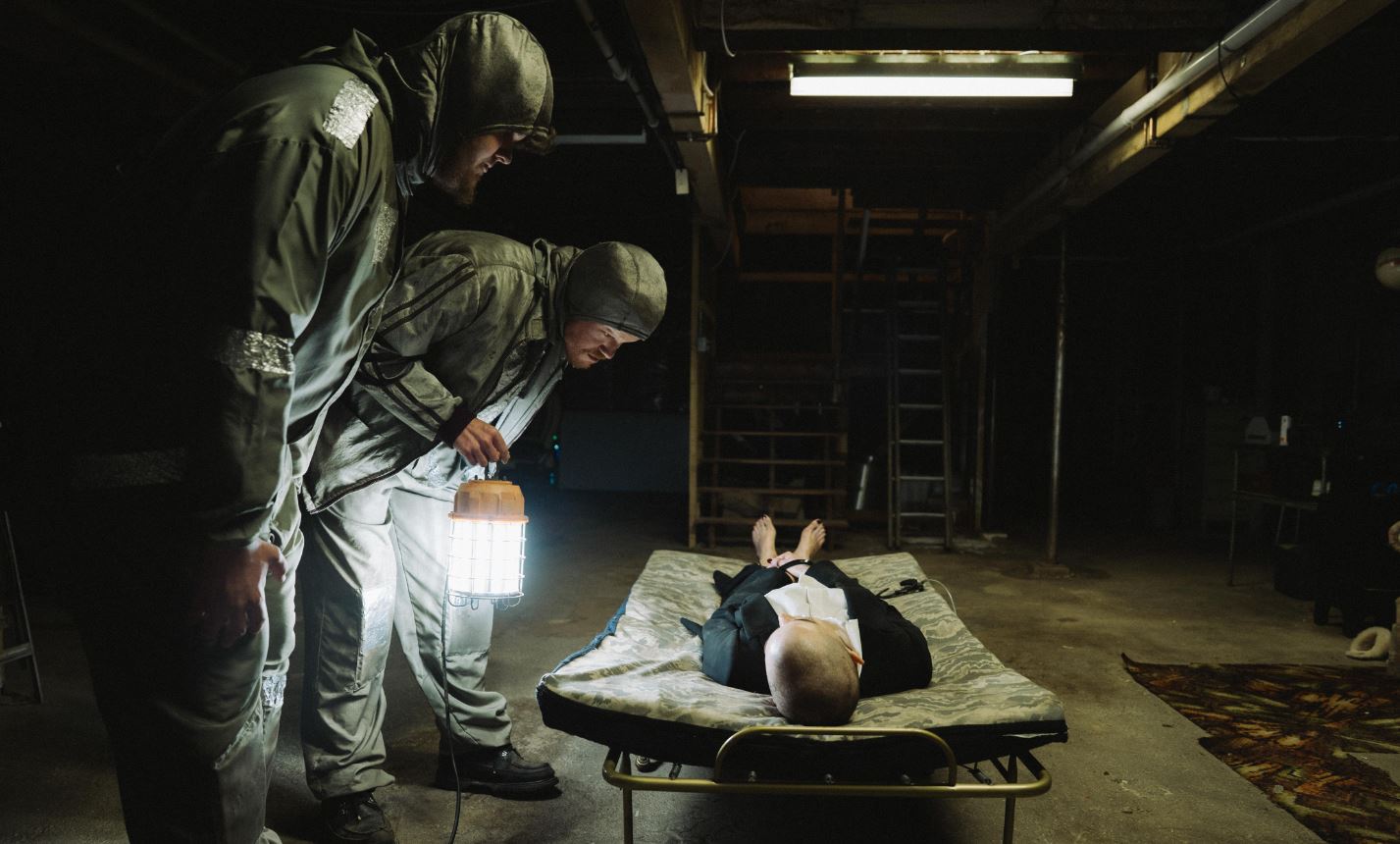
Emma Stone is equally captivating. Her character Michelle responds to Teddy’s delusions with a blend of strategic calm, intelligence, emotional restraint, and occasional vulnerability. Her performance doesn’t exist independently from Plemons’ — instead, she enriches his character by reacting in ways that intensify the film’s themes. She shapes her character through subtle emotional modulation, showing fear when needed, intelligence during moments of negotiation, and force when survival demands it.
A defining structural strength of Bugonia is its use of oppositional forces. Teddy and Michelle represent two strong, clashing worldviews. Teddy is driven by conspiracy, fear, and a desperate need for meaning, while Michelle embodies resistance, pride, and rational self-preservation. Their collision generates a series of escalating confrontations — physical, psychological, and philosophical.
At first, the conflict is purely physical, as Teddy violently kidnaps Michelle and she fights back with every survival instinct she has. Later, when both characters face each other in the basement, the tension turns inward. Dialogue becomes the weapon of choice, and their psychological manipulation deepens the mystery: is Teddy delusional, or is Michelle hiding something? The film toys with audience perception, purposely destabilizing our sense of truth.
As the narrative intensifies, cruelty grows. Teddy becomes more violent and unstable, while Michelle adapts, shifts strategies, and even feigns cooperation in order to survive. Their battle turns into a complex duel of identity, pain, power, and lies.

Interpreting Bugonia is difficult because the film intentionally undermines its own meaning. Just when the story appears to be making a clear philosophical statement, Lanthimos introduces a twist that throws every assumption into doubt. The film seems to be narrated from two opposing perspectives — each invalidating the other. This calculated ambiguity pushes the movie toward an atmosphere of absolute uncertainty and, ultimately, existential dread.
Lanthimos is a patient filmmaker. He lets his stories simmer, allowing tension and discomfort to accumulate. His signature use of black comedy, surreal exaggeration, and emotional coldness blends once again into a haunting exploration of the human condition. In Bugonia, he maintains an almost unbearable sense of suspense, building toward a final twenty minutes that force the viewer to confront their own anxieties about alienation, loss, and hopelessness.
By the end, we are left questioning humanity’s place in a world full of political, philosophical, and even cosmic conspiracies. Are we creators of meaning, or helpless observers of a slow societal collapse? Are we alone, or is the “alien threat” simply a metaphor for the people and systems that control our lives? Bugonia suggests that perhaps the most terrifying answer is that none of it has meaning — that nihilism itself is the lurking monster behind the curtain.
In the end, Bugonia is a gripping, unsettling, and philosophically rich film.
Lanthimos crafts a two-part journey: the first half excavates the deepest cavities of psychological trauma, while the second half plunges into cosmic absurdity and existential horror. With layered characters and remarkable performances, the movie keeps you engaged — but don’t expect comfort or catharsis. The world of Bugonia offers no tidy explanations, only the chilling echo of meaning dissolving into nothingness.

Leave a Reply